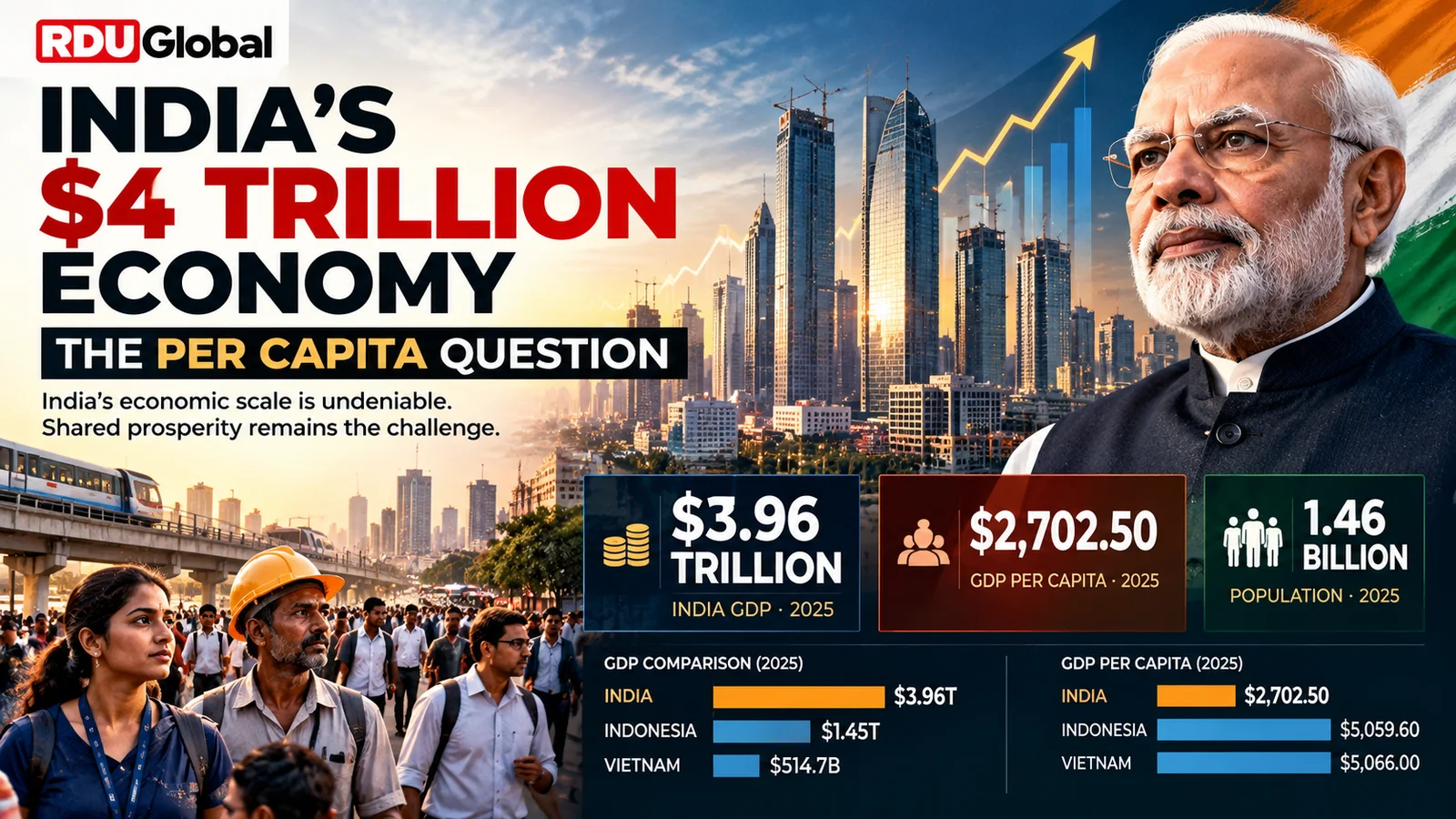
India’s Nearly $4 Trillion Economy Is Real. So Is Its Per Capita Problem.
The size of an economy and the prosperity of its people are different questions. Neither figure should be used to erase the other.
GDP estimates, CPI inflation, RBI Monetary Policy, GST council, Union Budget and trade balance.

The size of an economy and the prosperity of its people are different questions. Neither figure should be used to erase the other.

India’s ₹11.11 lakh crore infrastructure capex is no longer just a fiscal stimulus; it is becoming a structural industrial policy. The state is using highways, rail freight modernization, and defense indigenization to compress logistics costs, deepen domestic supply chains, and seed manufacturing clusters in Tier-2 and Tier-3 corridors. The wager is that public capex can crowd in private investment by reducing transport friction, improving asset utilization, and creating demand certainty for steel, cement, electronics, and precision engineering. But the transition carries trade-offs. Debt sustainability remains manageable only if growth and tax buoyancy stay firm, while employment gains are uneven because capital-intensive projects generate fewer direct jobs than labor-intensive welfare spending. The real test is whether NHAI corridors, Vande Bharat-linked logistics, and DRDO-HAL procurement can create second-order industrial ecosystems rather than isolated infrastructure assets. Early evidence suggests a stronger multiplier than in the past, but not yet a guaranteed manufacturing renaissance.

India's cumulative Foreign Direct Investment (FDI) has reached an unprecedented $843 billion from 2014 to 2026, with a record $94.53 billion inflow in the last fiscal year, according to Commerce and Industry Minister Piyush Goyal.

Gold prices experienced a slight uptick on Friday, yet are poised for a 2.1% decline this week as inflation concerns and rising U.S. Treasury yields diminish its safe-haven appeal. The Federal Reserve's recent interest rate hike has intensified fears of further increases, impacting gold's market perception.

The dollar fell sharply on Friday due to declining oil prices, while the yen strengthened following affirmations from Japan and the US regarding currency stability. Despite oil prices remaining above $100 a barrel, concerns over persistent inflation have prompted expectations of further interest rate hikes from the Federal Reserve.

Falling oil prices and a slight dip in US Treasury yields provide a lifeline for battered bonds, while stock markets thrive on AI optimism. However, consumer sentiment in the US has hit a four-month low due to inflation concerns.

The Indian rupee appreciated by 15 paise to close at 95.81 against the US dollar, bolstered by strategic interventions from the Reserve Bank of India. However, rising bond yields and external financing pressures continue to pose challenges for currency stability.

India's foreign exchange reserves have decreased by $4.9 billion to $780.7 billion, primarily due to falling gold prices. Analysts indicate that the inflow from FCNR(B) conversions is nearing completion, contributing to the decline.

As crucial employment and inflation reports loom, Wall Street braces for potential shifts in interest rate expectations. Rising Treasury yields and anticipated job growth may influence Federal Reserve policy and market reactions.

The Indian rupee is projected to trade within the range of Rs 94.5 to Rs 96 against the US dollar in the near term. Despite significant dollar inflows, the currency's appreciation remains constrained due to various economic factors.

In a significant political maneuver, CPI(M) General Secretary M.A. Baby has called for a broader coalition among opposition parties, proposing the formation of an INDIA Bloc-Plus. This initiative aims to consolidate forces against the ruling government ahead of the upcoming elections.

The Centre has lowered its gross market borrowing for FY27 to Rs 15.99 lakh crore, while keeping net borrowing at budgeted levels and leaning more heavily on longer-dated securities to manage debt costs and rollover risk. The finance ministry's second-half borrowing calendar also includes Rs 15,000 crore of sovereign green bonds, underscoring the government's effort to preserve fiscal credibility even as bond yields climb.

Union Finance Minister Nirmala Sitharaman said India is capable of achieving economic growth of more than 10 per cent, arguing that faster adoption of technology and innovation could lift productivity across agriculture, startups and industry. Speaking in Bengaluru, she said the country must overcome cynicism and accelerate its march toward Atmanirbhar Bharat and Viksit Bharat.